Why is it illegal to own a native turtle as a pet in Ontario?
Did you know that owning an Ontario-native turtle species as a pet is illegal?
With the aim of preventing declining population levels of native wildlife species, a federal legislation called the Species at Risk Act (SARA) was passed in late 2002 and put into full effect in mid 2004 (Parks Canada, 2024). SARA continuously updates its policies and regulations based on the Committee on the Status of Endangered Wildlife in Canada (COSEWIC). COSEWIC acquires lists of species and their risk designations developed by the provincial and territorial governments of Canada.
Our provincial list is called the Species at Risk in Ontario (SARO) and is managed and annually reviewed/updated by a committee known as the Committee on Status of Species at Risk in Ontario (COSSARO). Both COSSARO and COSEWIC are small independent groups made up of various government employees, wildlife experts, non-government organizations and scientists who use recent scientific evidence alongside Indigenous knowledge to determine designation status of risk per species (Government of Ontario, 2025). Both provincial/territorial (SARO and COSSARO) and federal (SARA and COSSEWIC) level organizations are needed because species’ populations may be affected differently from coast to coast and thus require different designation statuses and unique management plans.
According to COSSARO, all 8 of Ontario’s native turtles are at risk, with three species being endangered and one being threatened. The Eastern Box Turtle is no longer found in Ontario and has thus been designated as extirpated by COSSARO (COSSARO, 2017).
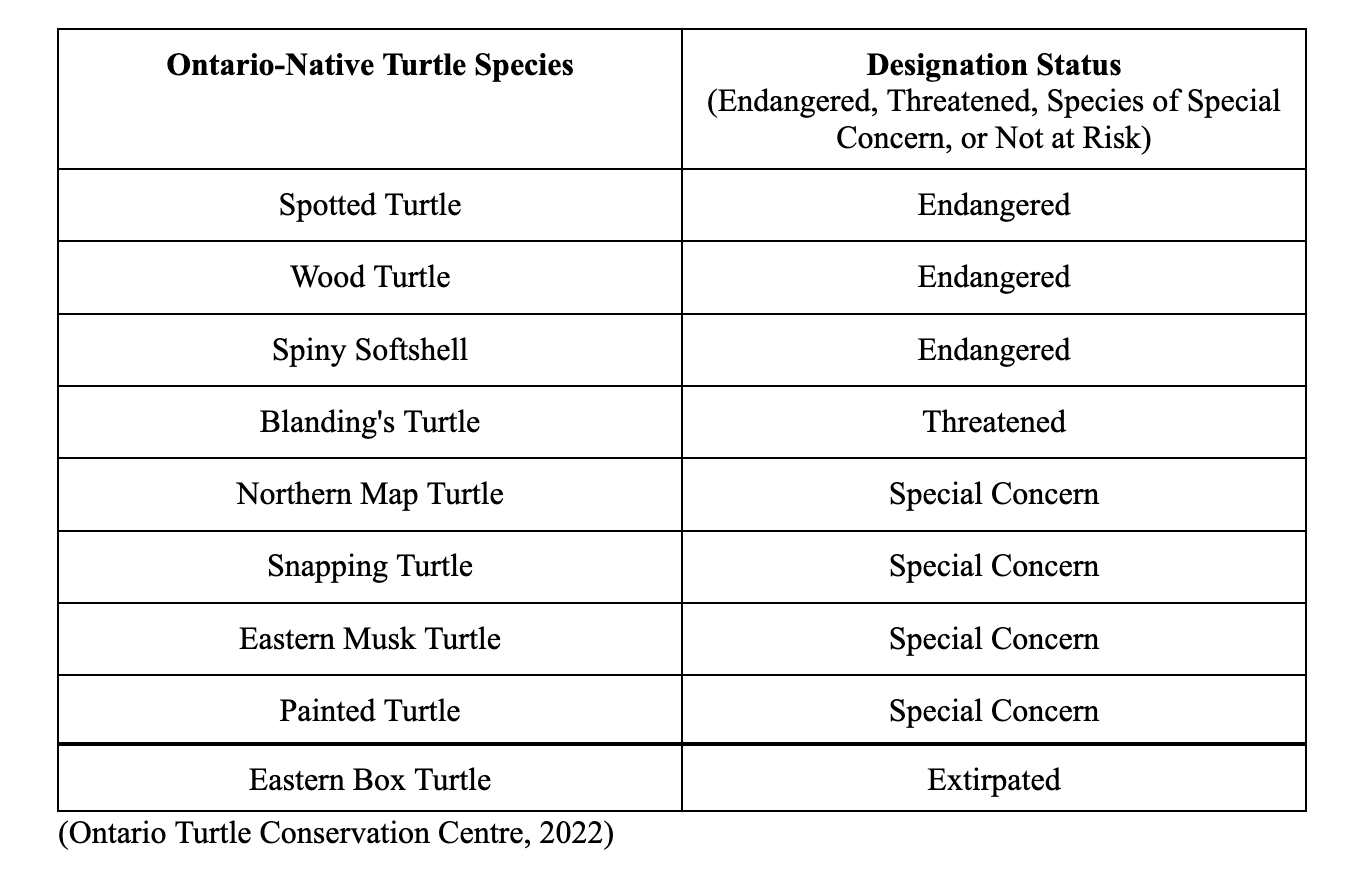
It is these designation statuses that make Ontario’s native turtles illegal to own. Under the Species at Risk Act (SARA), it is illegal to:
“kill, harm, harass, capture or take an individual;
possess, collect, buy, sell or trade an individual or any part of an individual;
and damage or destroy the residence of one or more individuals”
specifically, species listed as extirpated, endangered, or threatened (Parks Canada, 2024). Breaking these laws come with hefty fines and potential jail time.
One of the main reasons it is illegal to own one of these vulnerable species is due to the diminishing wild population levels. Ontario-native turtle populations are diminishing because of habitat destruction due to climate change and urbanization, road mortality and illegal human activity (Hopper, 2025). Because of their slow life cycle, it takes a long time for a turtle to become sexually mature and if individuals are not making it to this age, the overall population takes a long time to recover (Ontario Turtle Conservation Centre, 2022).
Adopting a baby turtle may seem like a cool idea at the time, but often times pet owners are neither prepared nor equipped for the size it will grow to or the longevity of its life (Cotterill, 2020). If deemed unfit to continue caring for the turtle, pet owners may think to release it to the wild, however this can have serious tolls on the individual as well as the pre-existing native community.
The term for releasing a pet turtle in the wild is known as turtle dumping. In captivity, turtles can grow larger than in the wild which can lead to competition of space, resources and food within the natural habitat. It has also been noted that turtles introduced to ecosystems after captivity can show a more aggressive behaviour towards the native community which can further impact the ecosystem (Cotterill, 2020). As well, pet turtles may have bacteria and illnesses that should not be released into native habitats. The opposite scenario can also be true; it can be very harmful to both turtle populations and the individual turtle for a wild turtle to be taken from its environment and kept as a pet. Without proper knowledge for how to care for a turtle, captive turtles can develop infections, growth issues, and be over all unhealthy to the trained eye.
The laws currently put in place aim to prevent these consequences from occurring in the first place.
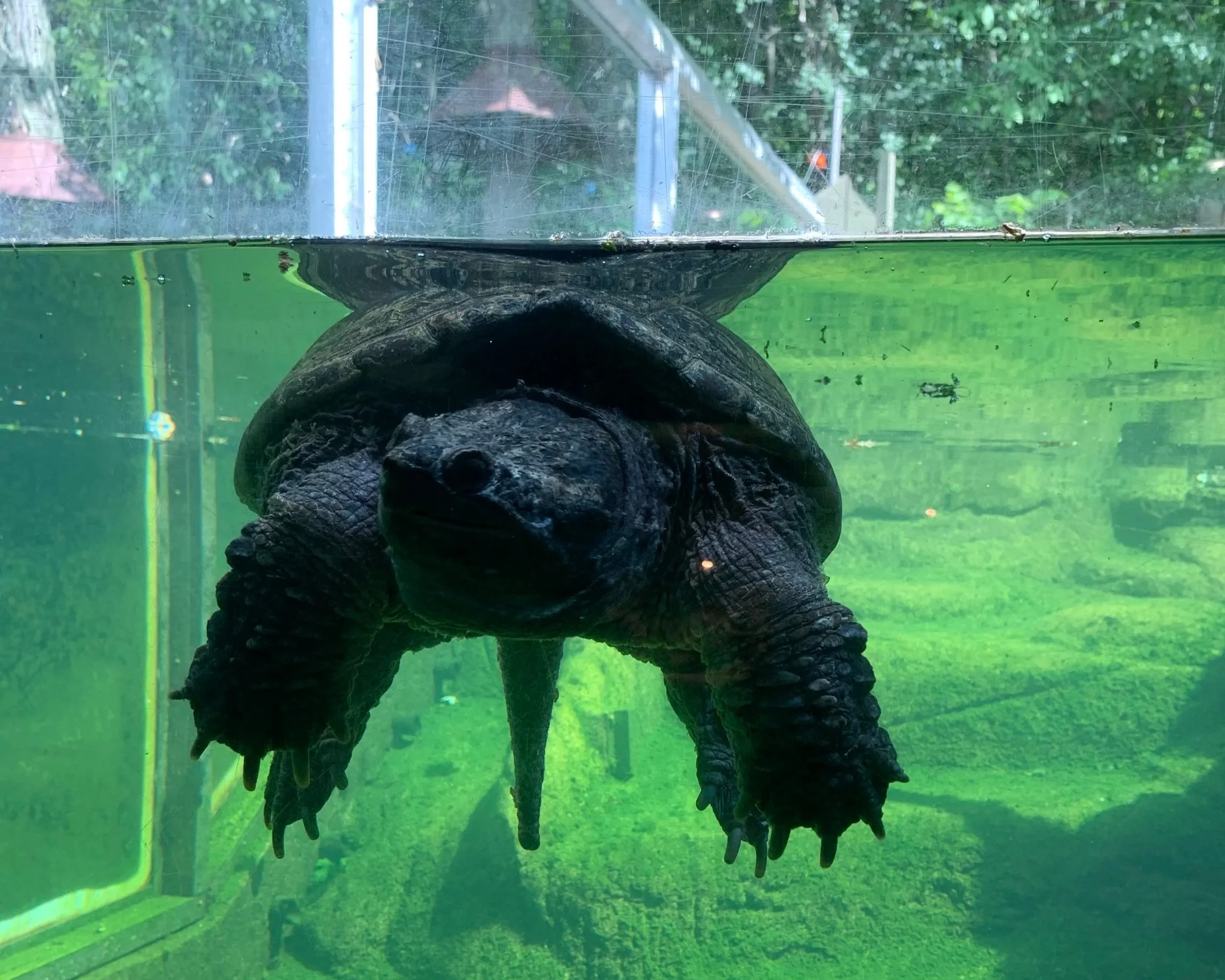
Native common snapping turtle at the Toronto Zoo
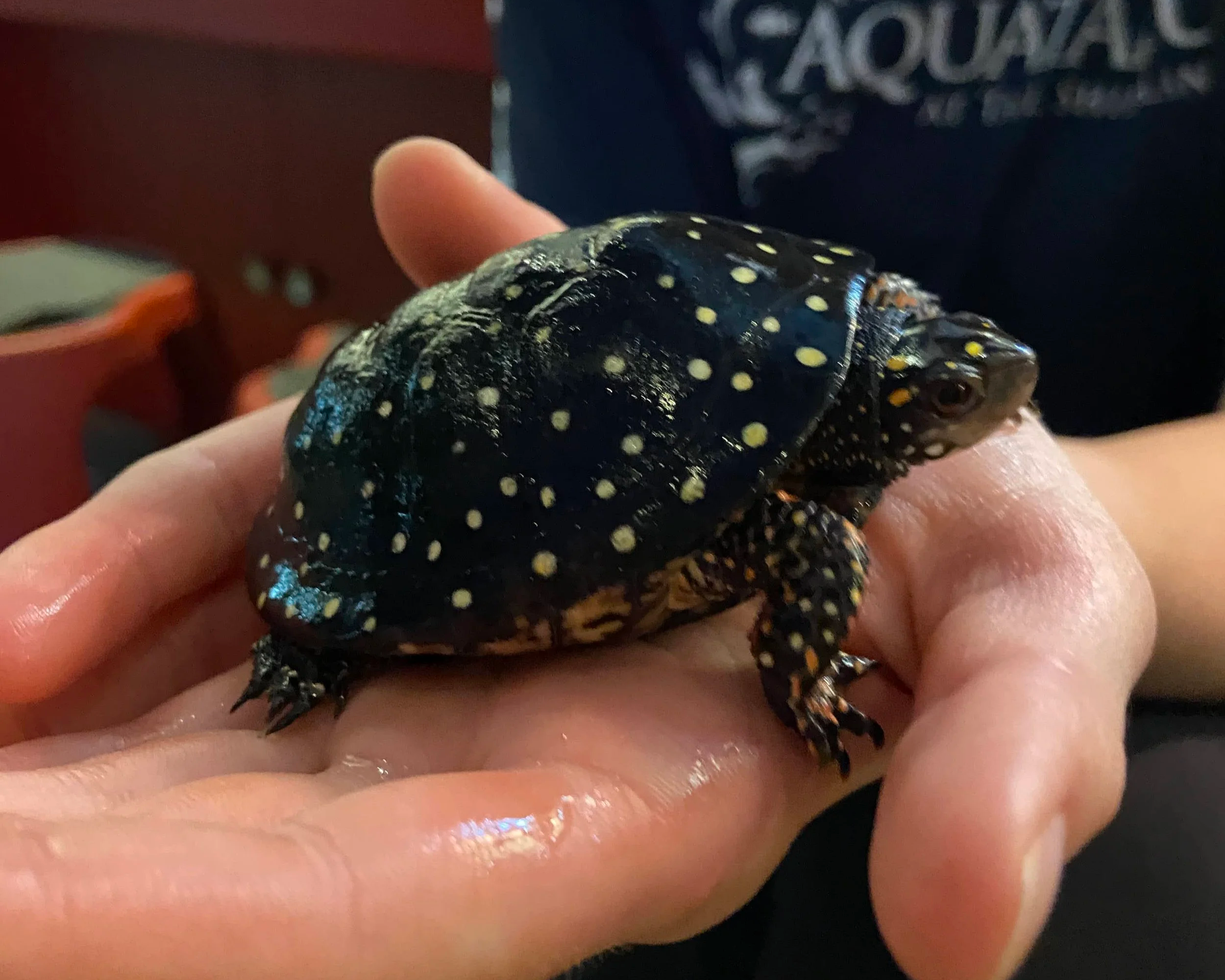
Native spotted turtle at the Brockville Aquitarium
You may notice some organizations are keeping native turtles (e.g. Ontario Turtle Conservation Centre, Toronto Zoo, Aquitarium, etc.). These organizations have permits and training allowing them to legally keep and care for the turtles. These turtles likely could not be rehabilitated to a state that would allow them to survive in the wild if they were to be released. Thus, they often become ambassador turtles used for educational purposes.
To stay informed on the designation statuses of species within Ontario you can visit: https://cossaroagency.ca/stay-informed/
References
COSSARO. (2017). Final-cossaro-evaluation-eastern-musk- ... http://cossaroagency.ca/wp-content/uploads/2017/06/Final-COSSARO-Evaluation-Eastern-Musk-Turtle_March-15_GFM-FINAL-s.pdf
Cotterill, M. (2020). Turtle dumping: Red-eared sliders are invading native turtle habitats in ontario | canadian geographic. Canadian Geographic. https://canadiangeographic.ca/articles/turtle-dumping-red-eared-sliders-are-invading-native-turtle-habitats-in-ontario/
Government of Ontario. (2025). How species at risk are listed. ontario.ca. https://www.ontario.ca/page/how-species-risk-are-listed#:~:text=An%20independent%20committee%20of%20experts,the%20Environment%2C%20Conservation%20and%20Parks
Hopper. (2025). Slow and deadly doesn’t win the race. Slow and Deadly Doesn’t Win the Race. https://blog.cwf-fcf.org/index.php/en/slow-and-deadly-doesnt-win-the-race/
Ontario Turtle Conservation Centre. (2022). Ontario Turtles. https://ontarioturtle.ca/turtles/
Parks Canada. (2024). What is illegal under the Species at Risk Act?. Government of Canada. https://parks.canada.ca/nature/science/especes-species/itm1/eep-sar1a