Winterkill
“there exists a level where it is too cold for the turtle to survive in this brumation state; this is known as winterkill.”
It is no secret that Ontario winter temperatures can get very cold, during these months it can be easy for us to prefer the indoors. This however is not an option for wild Ontario-native turtles. Instead they must rely on picking a safe spot at the bottom of their pond/lake and hope it can provide enough oxygen to survive the winter in its entirety. They do this through a physiological process called brumation (a type of overwinter hibernation) by switching their metabolism from aerobic (requiring oxygen intake) to anaerobic (not requiring oxygen intake; Navarette 2019, O’Halloran 2022).
As the supply of oxygen intake is not constant in their underwater brumation site, anaerobic metabolism better controls the turtles’ biochemical processes to minimize energy expenditure and maximize efficient energy use. Since turtles are ectotherms, their internal temperature will match that of the external environment. During brumation, turtles lower their heart rate and require less oxygen intake, acquiring oxygen through absorption rather than breathing (O’Halloran 2022). (Check out this past blog post to learn more about how turtles survive the winter).
Although there is a positive correlation between lower temperatures and lower metabolic needs, there exists a level where it is too cold for the turtle to survive in this brumation state; this is known as winterkill (Seburn 2022, Platt et al. 2008). Winterkill is unfortunately not uncommon in Ontario and can be linked to climate change, particularly changing temperatures throughout the season. Periods of freezing temperatures followed by periods of warmer temperatures can alter the level of the non-frozen area at the bottom of the pond/lake in which the turtles reside. A safe brumation site is one in which the temperature and oxygen content is stable (O’Halloran 2022). Temperatures below freezing can deplete oxygen availability thus changing metabolic needs at a rate and extent that the turtle cannot adapt to, a term known as anoxia (O’Halloran 2022). In some cases the temperatures drop so low that the pond completely freezes to the bottom which lethally restricts access to all resources needed to survive ultimately leading to death.
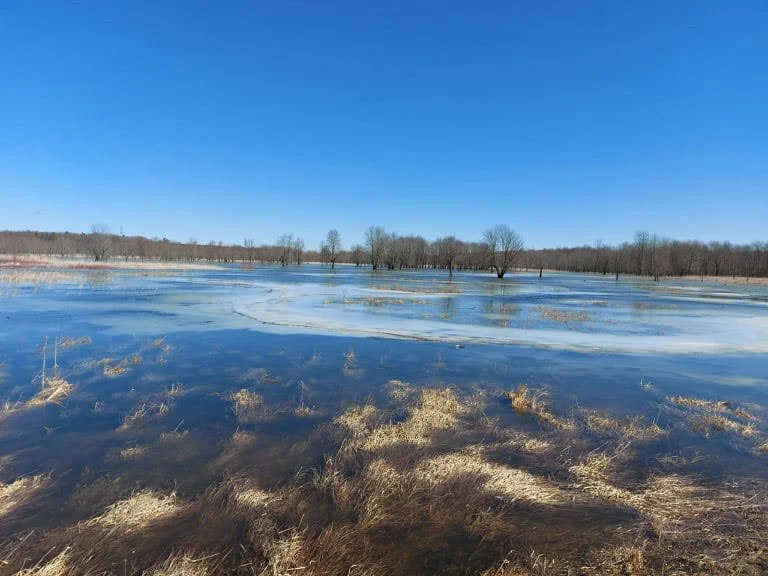
Winterkill is an important concept to understand as it can have significant impacts on overall ecological health. Also, mass mortality rates of Ontario-native turtles can have long-lasting impacts on their population levels (Seburn et al. 2021). By tracking the yearly rates of winterkill in Ontario, proper measures can be put in place to attempt to prevent this life-threatening partly-anthropogenic phenomenon from occurring to this extent.
How to report winterkill in Ontario:
If you happen to come across an injured or deceased turtle in Ontario you can contact the Ontario Turtle Conservation Centre at 705-741-5000. You can also report all turtle sightings on iNaturalist or to the Government of Ontario - learn more here.
References
Navarrette, A. (2019). Brumation in Turtles and Tortoises. Texas Veterinary Medical Foundation. https://www.tvmf.org/articles/brumation-in-turtles-and-tortoises/
O’Halloran, A. (2022). The overwintering struggles of freshwater turtles in Ontario. Turtle Guardians. https://www.turtleguardians.com/2022/12/the-overwintering-struggles-of-freshwater-turtles-in-ontario/
Platt, S., Horse, Z., Cross, W., Mannel, S., & Rainwater, T. (2008). Winterkill and Biomass of the Painted Turtle in a South Dakota Wetland. University of Nebraska. https://digitalcommons.unl.edu/cgi/viewcontent.cgi?article=1218&context=tpn
Seburn, D. (2022). How do freshwater turtles survive a Canadian winter?. The Canadian Wildlife Federation. https://blog.cwf-fcf.org/index.php/en/how-do-freshwater-turtles-survive-a-canadian-winter/
Seburn, D., Burns, M., Akinrinola, I., Cecile, S., Farquharson, T., Hung, C., & McIntyre, P. (2021). Apparent winterkill of Painted Turtle (Chrysemys picta). The Canadian Field-Naturalist. file:///Users/rebeccabrown/Downloads/2709-Article%20Text-13521-1-10-20220428%20(1).pdf