Helping Turtles
There are many actions you can take to help our local Ontario turtles. Read below to learn more about helping injured turtles, protecting turtle nests, how to safely move turtles, where to report your sightings, how to help debunk myths, volunteer opportunities with Turtles Kingston, advocacy opportunities, and organizations that you can support through donations.
Bring injured and dead turtles to get help
With a slow metabolic rate and amazing regenerative healing abilities, turtles can survive significant injuries that would be fatal in mammals and birds.
A turtle you find may look so fractured and broken that it cannot be helped. Even in these situations it is best to bring the turtle to receive treatment as you’d be surprised what can be done to help heal a turtle!
Even if a turtle appears dead, it may be that they have slowed their metabolism to the point of appearing dead, but they are still very much alive. These turtles require an experienced rehabilitator to determine if they are indeed dead, in need of euthanasia, or if they can be rehabilitated.
Even if the turtle itself is dead, they may be a gravid female, in which case, eggs can be extracted and incubated if rescued within 24 hours.
Protect a turtle nest
Turtle nests are regularly destroyed by predators like raccoons, otters, foxes, and crows. In fact, less than 1% of turtle eggs survive to sexual maturity. The low egg survival rate means that it can take 59 years for a turtle to replace itself!
You can help reduce the success of predation (which is near 100% in urban areas) and help improve turtle recruitment into the population by protecting a turtle nest. It is important to protect the nest as soon as possible, since most predation occurs within the first couple of days after nesting! However, predation can occur at any point in time, so leave those nest protectors on!
Move turtles out of danger
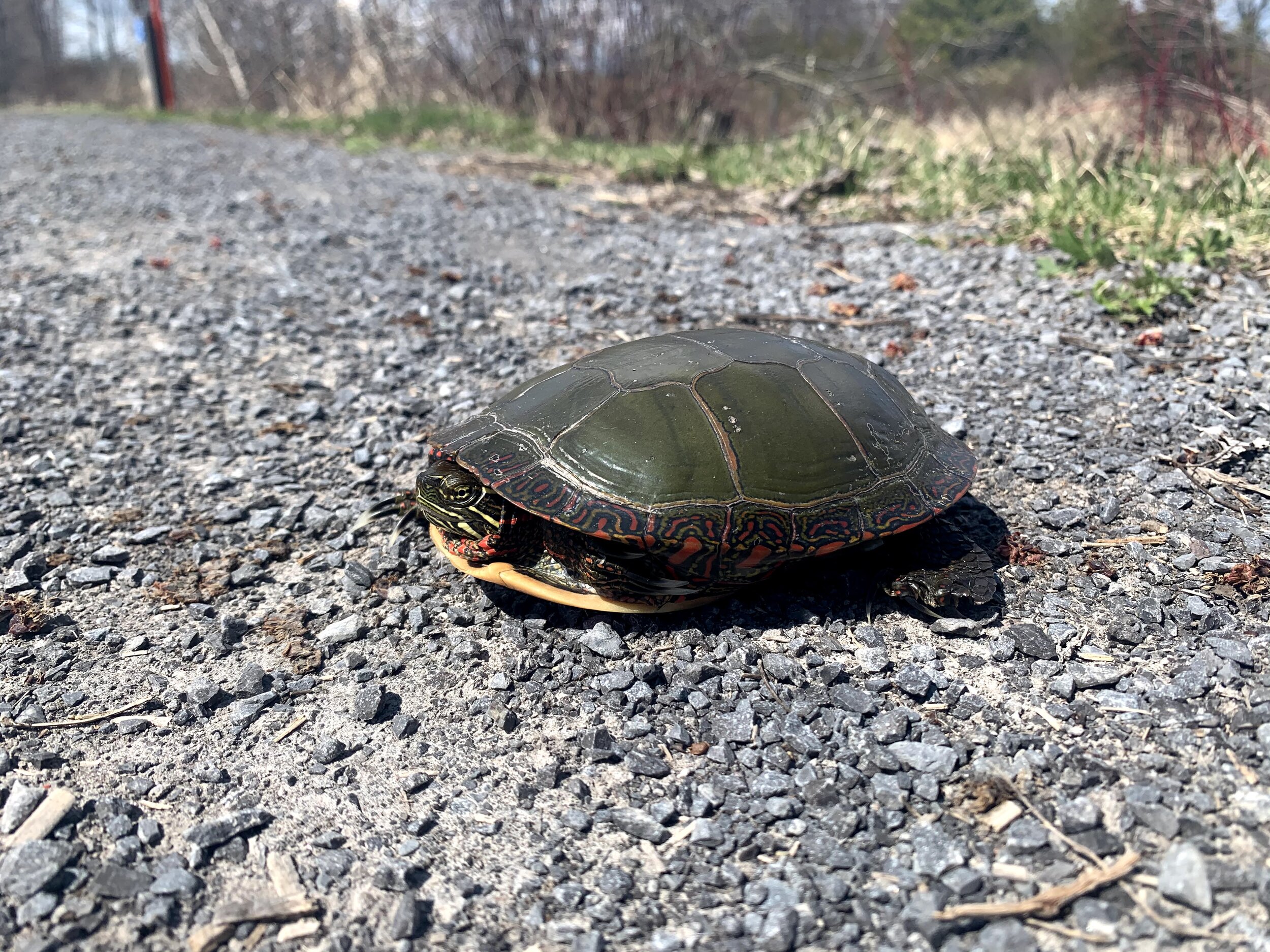
Turtles are slow moving reptiles that will often cross roads and trails while moving within their habitat. You can help ensure these turtles don’t get injured by helping move them across roads, in the direction they were headed, when it is safe for you to do so.
One of the biggest impacts you can make for turtle conservation is helping an adult turtle! The loss of one adult turtle could take 59 years to replace! So, taking that extra time to pause and help a turtle cross the road is critical for the survival of our Ontario turtle species.
Report your turtle sightings
The more we know about turtles, the better we can protect them. Specifically, knowing where they are found can help us to protect their habitats. If you find a turtle, report your sighting on iNaturalist or directly to the Ontario Government Natural Heritage Information Centre. For turtles on roads in Kingston, you can submit your observations directly to us. Beyond these two locations, please keep turtle locations private, as there are poachers that target Ontario turtles.
Debunk myths
The common snapping turtle found in Ontario is often associated with many falsehoods.
The perpetuation of the myth that they are ‘aggressive' and can ’bite off fingers and toes’ only reduces their chance of survival as people will be less inclined to want to help them in situations of need because of their unsubstantiated fears.
🚨 Snapping turtles will bite off your fingers!
❌ No, the Common Snapping Turtle found in the Kingston area, does not have the strength in their jaws to ‘bite off fingers’ or ‘break broom handles’.
🚨 Snapping turtles are aggressive!
❌ No, the only reason they ‘snap’, making them appear to be aggressive, is because their plastron (bottom shell) is too small for them to be able to retract into when they feel threatened. Their only measure of defense is to ‘snap’. They are trying to intimidate you, they are not naturally aggressive.
The nesting females you meet on the roadsides can be ‘testy’ because they are less comfortable on land and are on a mission to lay their eggs. They will be sensitive about being approached because of their heightened vulnerability. Their response to you will be one of defensiveness, NOT aggression.
BIG difference!
Volunteer with Turtles Kingston
We recruit volunteers between March and May each year for positions such as turtle monitor, community turtle ambassador, volunteer driver, event helper, informational booth support, and as part of our larger coordinator team.
Advocate for habitat protection
Habitat loss is the main cause of turtle population decline. Wetlands are a crucial habitat for turtles and other species, yet 70-90% of wetlands have been lost to development. This has led to serious fragmentation of the turtles’ habitat. Fragmentation of their homes means that both male and female turtles must cross the many roads that intersect their wetlands in search of food sources and potential mates.
Not only are wetlands important for turtles in terms of food and shelter, but they are also important for us in terms of carbon sequestering and flood mitigation.
Donate to your favourite turtle organization
Turtles Kingston is a not-for-profit that operates thanks to the generous donations from people like you. Our coordinators and director are volunteers and donations go to supporting and growing turtle programs.
Beyond Turtles Kingston, there are many other wonderful organizations in Ontario working to support turtle species. Find an organization near you and learn what they do to help turtles with the Ontario Turtle Conservation Network.