Why all the concern? - Alto high speed rail
by Emily Wright, Advocacy Coordinator Turtles Kingston
A Line on a Map.
We make maps with a lot of different lines. Country borders, cities, roads and highways crisscrossing the land this way and that, as Canada’s population grows, so do our cities, so does our industry and need for connectivity. We need more and more lines in order to connect to each other, connection I think is something we all can appreciate is integral to our economy, community, and personal health. Connections to work, to each other - connection is what fuels the human experience.
What is ironic in the case of the proposed ALTO High Speed Train line, is that it is offering a genuinely much needed connection between some of Canada’s largest cities! Increased public transit? Yes please! Yet the very method and routes they are proposing are severing hundreds of kilometers of connection - forests, wetlands, even communities and farms are being threatened with isolation.
What ALTO is proposing is a line on a map.
For turtles and other wildlife, this (almost) impenetrable wall may be the difference between survival and a slow and irreversible decline in population, especially for some of our most at risk species.
What is Alto?
Alto is a federal government subsidiary that is managing a project to plan and develop a High Speed Rail project connecting Toronto to Québec City. It is being framed by Alto (a subsidiary of VIA Rail) and the Federal Government as a bold step toward modern, low-carbon transportation (electrified rail) - a transformative investment in faster, more reliable passenger rail, with trains reaching speeds of up to 300 km/h (https://www.altotrain.ca/en/about-alto).
At first glance, the idea is compelling: faster travel, reduced reliance on cars and planes, and a step toward a greener future.
But as with any project of this scale, the details matter—and so do the trade-offs.
Why?
Emissions reduction is the main positive environmental outcome that is being pushed by pro-ALTO proponents, that the rail line could remove up to 100,000 cars and a large percentage of short haul flights between Toronto and Montreal alone. However, it seems likely that is overestimating the number of people who will choose to use this new, likely expensive, transportation option. In addition, the proposed route has limited station stops that will be located only within large communities receiving the service, the smallest of which is Peterborough.
Why Not?
If we look to countries where the implication of high-speed rail has been successful, such as France and Japan, they share one key characteristic that Canada and the proposed routes do not have; dense populations and closely connected urban centres.
In lower-density regions, similar projects have struggled.
In the United Kingdom, the HS2 project has faced escalating costs, ridership/equality concerns (that the service will benefit higher income versus average citizens), environmental concerns, and major route changes and cancellations (https://www.bbc.com/news/articles/cx2l8kq52y8o). Instead of becoming a “nation building project”, it has become a years-long sham and waste of public money. A big mistake they made, they jumped straight on HS2 as the best solution to a much more complex problem without doing a comprehensive cost benefit analysis to compare existing, slower trains with the ridership and economic benefits of high speed, (https://www.bbc.com/news/articles/cx2l8kq52y8o). As Andrew Gilligan, a former advisor to Boris Johnson and Rishi Sunak, put it:
“The answer to our transport crisis is lots of boring little things like bus lanes and tram systems and new stations… and not one grand mega-project that is in fact only going to touch a handful of people in the country.”(BBC)
Similarly in the United States, California’s high-speed rail project has faced similar challenges, with Reuters reporting significant cost overruns and delays. The idea was sound, let's make faster, better transit to offset emissions, but the planning and execution, and a failure to look at much more impactful alternatives, have led to years of financial hardship and increasing public dissent.
These examples do not mean rail investment is a bad idea—but they highlight the risks of getting it wrong.
There are also more immediate practical concerns. The proposed Alto service would stop in relatively few communities, raising questions about accessibility and ridership. If it primarily serves major urban centres and business travel, it risks leaving many Canadians behind—despite being publicly funded.
And while the emissions argument is important, it cannot be considered in isolation, especially when the environmental cost of building this system is so significant.
Because what is being proposed is not just a rail line.
It is a continuous, controlled corridor cutting through Southern Ontario. A miles-long barrier that will sever ecosystems, fragment habitat, and permanently alter some of the most sensitive landscapes in the province.
A line through the Forest (And wetland, and Community, and Farm…)
Both Northern and Southern proposed routes cut through intact forests, wetlands, farmland, and communities.
Of particular concern is the Frontenac Arch Biosphere, a UNESCO-recognized region that serves as a critical ecological bridge between the Canadian Shield and the Adirondack Mountains. This is not just a scenic landscape, but a functioning ecological corridor that supports exceptional biodiversity and allows species to move across the land.
Within this region lies one of eastern North America’s last uninterrupted north–south wildlife corridors: the Algonquin-to-Adirondacks corridor (https://www.a2acollaborative.org/). This corridor is essential for maintaining biodiversity, particularly as climate change forces species to shift their ranges in search of suitable habitat.
Connectivity is not a luxury—it is survival.
And this is exactly what the project puts at risk for the environment.
Communities, roads, farms, conservation areas, and private lands will be fractured. Wetlands and marshes will be bisected. Natural drainage systems may be altered, changing water levels and degrading already sensitive ecosystems.
The importance of protecting these landscapes is well understood and established. Wildlife depends on continuous habitat corridors that allow species to move safely to feed, shelter, and reproduce.
Fragmentation breaks that system.
For many species, this is harmful.
For turtles, it is devastating.
Turtles - Divided. Will Fall.
All of Ontario’s turtle species rely on movement between habitats—wetlands for feeding, upland areas for nesting, and deeper water for overwintering. These movements happen every year, along the same routes, across generations.
When those routes are cut, turtles do not adapt quickly. They attempt to follow the same paths, until they encounter barriers they cannot cross. Often they will follow fences and other barriers until they can cross, considering the breadth and size of the ALTO corridor, passages will be few and far in between.
Trapped individuals, in isolated patches of habitat, means their nesting sites become inaccessible. Wetlands disconnected. Individuals are forced into limited crossing points with the potential for increased mortality (https://www.nature.com/articles/s41598-020-67340-8).
Over time the effect on turtles, and many other species at risk, will be dramatic and spread over an immense area.
This is not hypothetical.
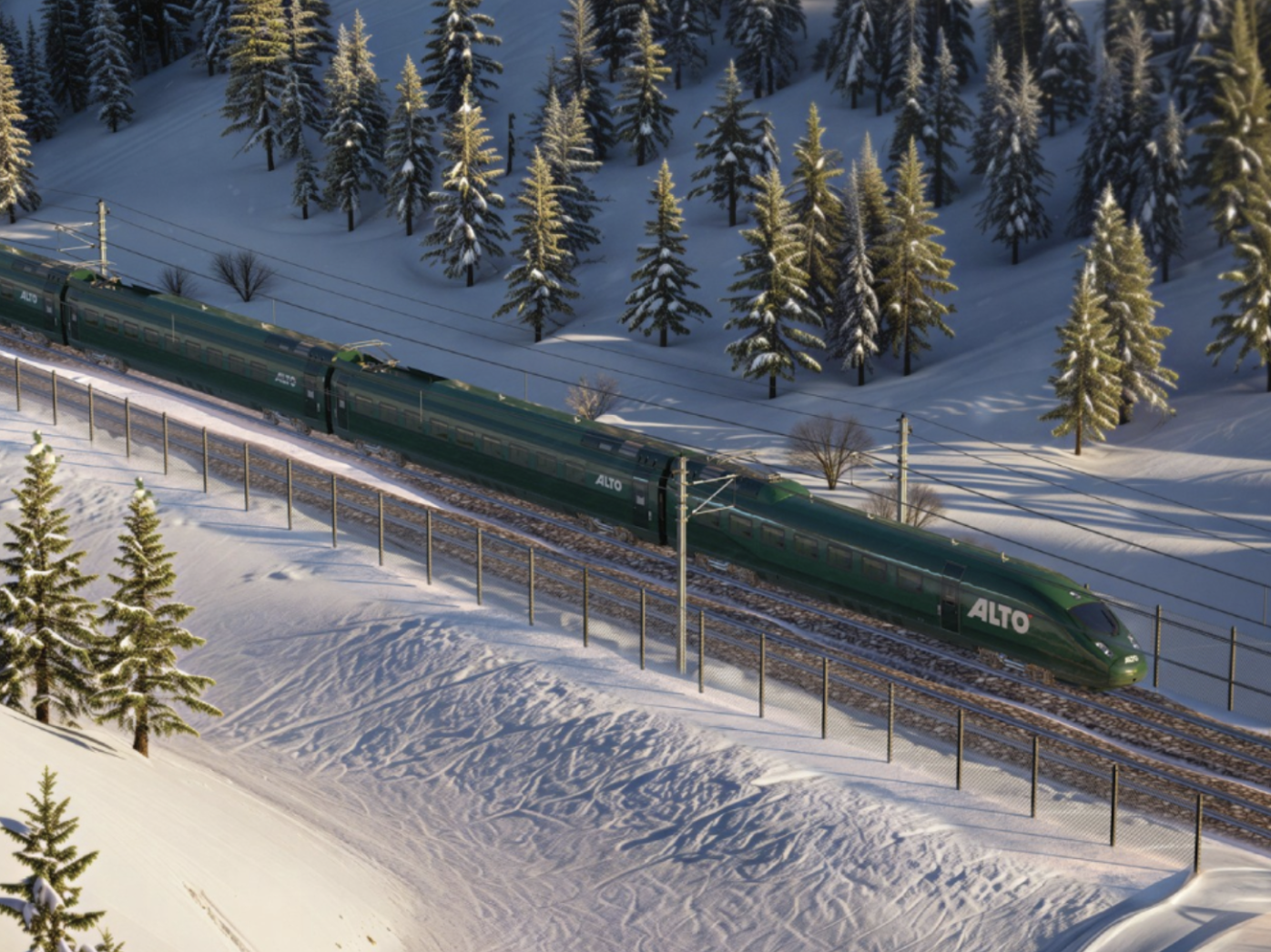
(concept art of ALTO’s High Speed Rail line and fencing: https://www.altotrain.ca/en/about-alto/whats-happening)
A landmark study by Gibbs and Shriver (2002) found that even small increases in adult mortality can cause turtle populations to collapse. So even if just a few adult turtles are not able to reach or find their overwintering ponds before winter each year, there is a very real risk of the population facing irreversible harm. In addition, Rytwinski and Fahrig (2012) have shown that reptiles and amphibians are among the most negatively affected groups when habitats are fragmented by transportation infrastructure.
High-speed rail intensifies this problem. Unlike traditional rail, it requires fully fenced, controlled corridors with very limited crossing points.
In effect, it creates a continuous, impassable wall across the landscape.
Once fragmentation occurs at this level, the damage is effectively irreversible.
Alternatives
At the same time, Canada already has an intercity rail system that is struggling.
VIA Rail—one of the main partners in this project—operates on shared freight tracks along the 401 corridor, leading to delays, long travel times, and high ticket prices. For many Canadians, rail travel is unreliable not because the concept doesn’t work, but because it has not been properly supported.
Before building something entirely new, there is a strong argument for improving what already exists.
Upgrading and electrifying current rail lines could improve reliability, reduce emissions, and expand access, without cutting through sensitive ecosystems or creating new barriers.
There are also examples of where high speed rail has taken more environmentally conscious approaches. In the United States, Brightline has successfully developed high-speed rail while minimizing land disruption by following existing corridors like the median between highway lanes (https://www.brightlinewest.com/construction).
Ontario already has a similar opportunity with the 401 corridor—one that could serve more communities while avoiding mass ecological damage.
So the question is not whether we invest in rail.
It is how we do it.
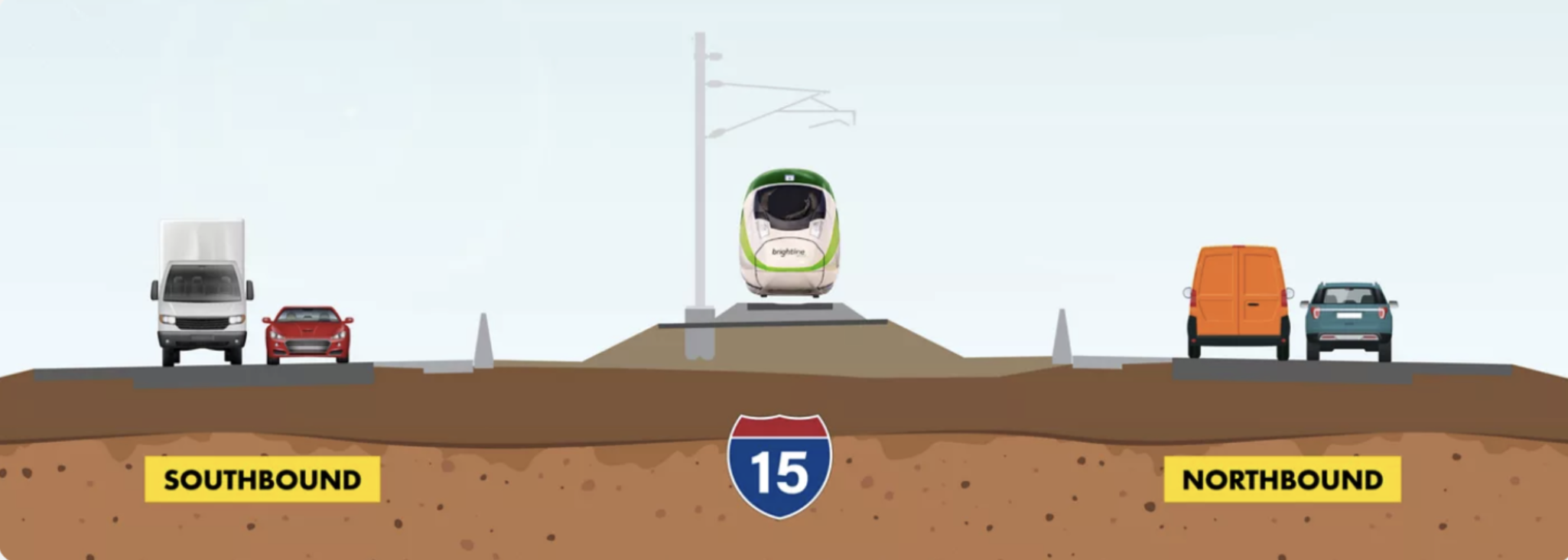
Brightline proposal- running in the median of the I-15 (https://www.brightlinewest.com/construction).
We NEED Public Transit - Let’s Do it RIGHT.
Are we building a system that serves the public? Are we protecting the ecosystems that sustain biodiversity? Are we making decisions based on long-term impact rather than short-term optics?
Or are we accepting permanent, irreversible environmental damage in the hope of reducing a relatively small portion of emissions?
Reducing greenhouse gas emissions is essential. But it should not come at the cost of destroying sensitive habitat, endangering already at-risk species, and creating permanent, impassable fragmentation, one of the leading drivers of biodiversity loss.
We have an opportunity to do this differently.
We can build a transportation system that serves the public, protects our ecosystems, and reduces emissions.
But achieving all three requires thoughtful planning and not extreme compromises.
Once these landscapes are divided, they cannot be put back together.
Ultimately, this conversation is not about whether Canada should invest in rail.
It is about how we do it and at what cost.