How do turtles select their nesting site?
Thank you to Pasquale Busa for guest authoring this month’s blog post.
Turtles in Ontario select their nesting sites based on environmental factors that influence the survival of their eggs. Generally, they look for areas with loose, well-drained soil or sand, open exposure to sunlight for warmth, and proximity to water. However, there are differences between species in their nesting preferences.
Painted Turtles
The Painted Turtle (Chrysemys picta) is one of North America's most widespread freshwater turtle species, boasting an extensive and northerly range. This broad distribution is largely attributed to the species' remarkable adaptability and cold tolerance, allowing it to thrive in diverse environments.
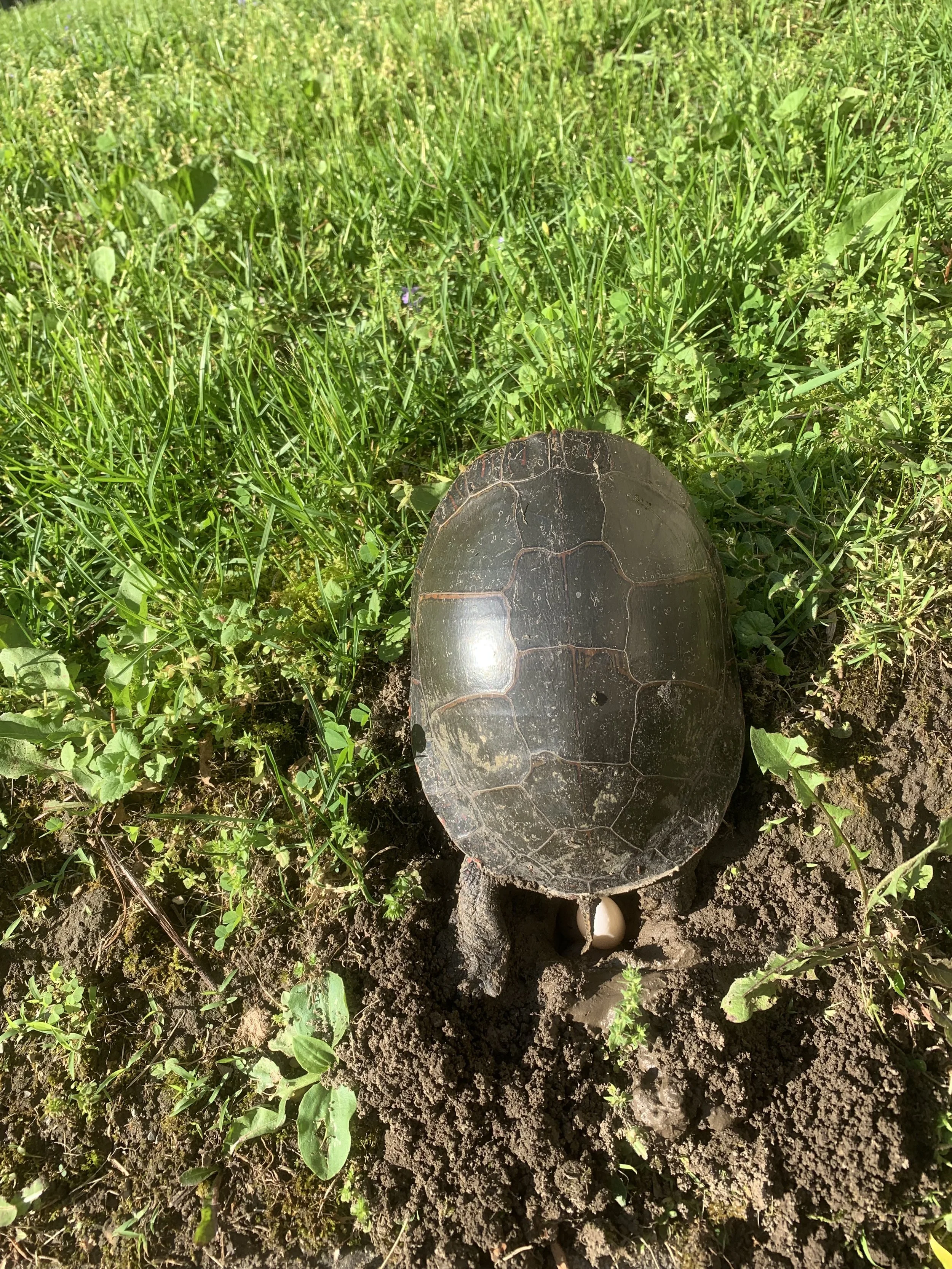
Midland painted turtle nesting in some grass and dirt
In Canada, the Painted Turtle's range is fragmented, spanning from British Columbia in the west to New Brunswick and Nova Scotia in the east. Within this range, three subspecies are found:
Western Painted Turtle (C. p. bellii): This subspecies occupies a range extending from British Columbia to northwestern Ontario. It was recently reassessed by the Committee on the Status of Endangered Wildlife in Canada (COSEWIC) in 2016.
Midland Painted Turtle (C. p. marginata): Found in Ontario and western Québec, this subspecies extends southward into the Great Lakes and Ohio Valley regions.
Eastern Painted Turtle (C. p. picta): This subspecies is distributed across New Brunswick, Nova Scotia, and the Atlantic coastal states, remaining east of the Appalachian Mountains.
Painted Turtles nest between late May and early July, selecting sites with soft, sandy, or loamy soil that receive ample sunlight to aid in incubation. These sites are typically located within 200 meters of water, allowing hatchlings easy access to aquatic habitats. Before committing to a final nest, females may dig several nests that they then abandon. It isn’t known why they do this, it might be to deter predators but is more likely a result of being unsatisfied with the nesting site or because they were interrupted.
Using their hind feet, they excavate a flask-shaped nest approximately 10 to 12 centimeters deep, where they lay between 3 and 15 oval, soft-shelled eggs. The eggs incubate for 60 to 90 days, with the nest temperature playing a crucial role in determining the sex of the hatchlings a process known as temperature-dependent sex determination (TSD). Warmer temperatures generally produce more females, while cooler conditions result in more males, although both sexes will hatch from a single nest.
Understanding these nesting habits is essential for conservation efforts, as habitat loss and human disturbances can significantly impact reproductive success. Protecting nesting sites is one aspect of ensuring the continued survival of this resilient species.
Blanding’s Turtle
The Blanding’s Turtle, often called Ontario’s smiling turtle due to its distinctive upward-curved mouth, is a semi-aquatic species that thrives in a variety of wetland habitats. Found in ponds, marshes, shorelines, and slow-moving waters like lakes, streams, and rivers, this species relies on diverse environments to meet its seasonal needs. While primarily aquatic, Blanding’s Turtles also spend time on land, particularly when migrating between different habitats. Their home ranges can be quite large, incorporating multiple habitat types to support their life cycle.
Blanding’s Turtles nest in late spring and early summer, typically from late May to early July. Their nesting activity peaks in the evening hours, with females often beginning to dig nests in the late afternoon and completing the process after dark. These turtles are known for traveling significant distances sometimes up to 6 km from their wetland habitats in search of suitable nesting sites.
They prefer open areas with minimal vegetation and high sun exposure, which help regulate nest temperature and support successful incubation. Common nesting locations include forest clearings, meadows, shorelines, beaches, rock outcrops, road shoulders, gravel roads, fields, gardens, and power line rights-of-way. After selecting a suitable nesting site, the female Blanding’s Turtle begins the nest excavation process, digging a shallow depression in a sandy or gravelly area. Once the nest is prepared, she lays a single clutch of 4 to 13 eggs, carefully placing them within the nest cavity.
To protect her eggs from predators and environmental threats, she then covers the nest with soil and vegetation, effectively camouflaging it within the surrounding landscape. This natural nesting behavior plays a crucial role in ensuring the survival of the next generation of Blanding’s Turtles.
Common snapping turtle
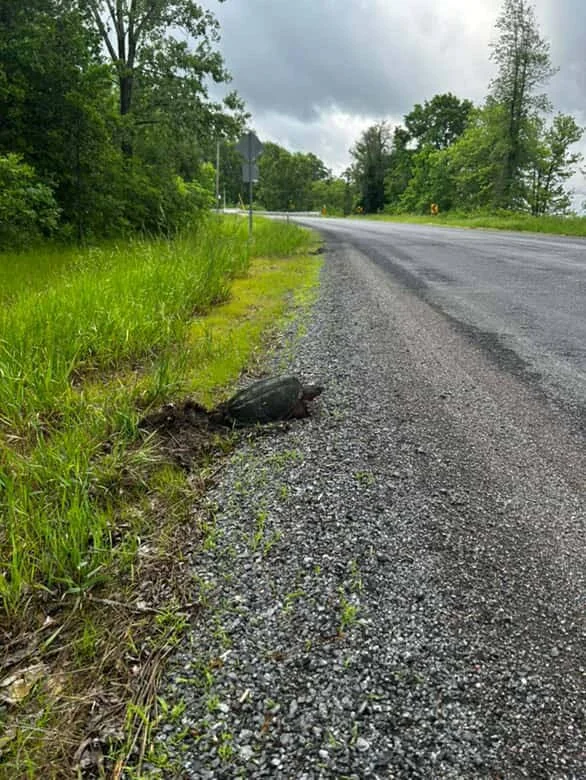
Common snapping turtle nesting on the side of a road in the gravel shoulder
The common snapping turtle is a fascinating freshwater species that belongs to the Chelydridae family. Found across a wide range, it can be spotted from southeastern Canada, stretching southwest to the edges of the Rocky Mountains, and as far east as Nova Scotia and Florida.
Did you know that snapping turtles can live to be over 100 years old? They’re not just survivors of the wild, they’re practically living legends!
Snapping turtles are most active from late March to October, with their nesting season typically occurring between late May and early July. During this time, females travel overland in search of suitable nesting sites, often preferring areas with loose, sandy soil such as roadsides, embankments, or shorelines. They may also choose human-made structures like gravel shoulders, dams, and aggregate pits. Once a site is found, the females use their powerful hind legs to dig a shallow, bowl-shaped nest, where they lay a clutch of 20 to 40 creamy white eggs, each about the size of a ping-pong ball. The eggs are incubated by the sun’s warmth, with an incubation period ranging from 65 to 95 days. Hatchlings typically emerge in late summer to early fall, between late August and early October, and instinctively make their way toward the water.
Northern Map Turtle
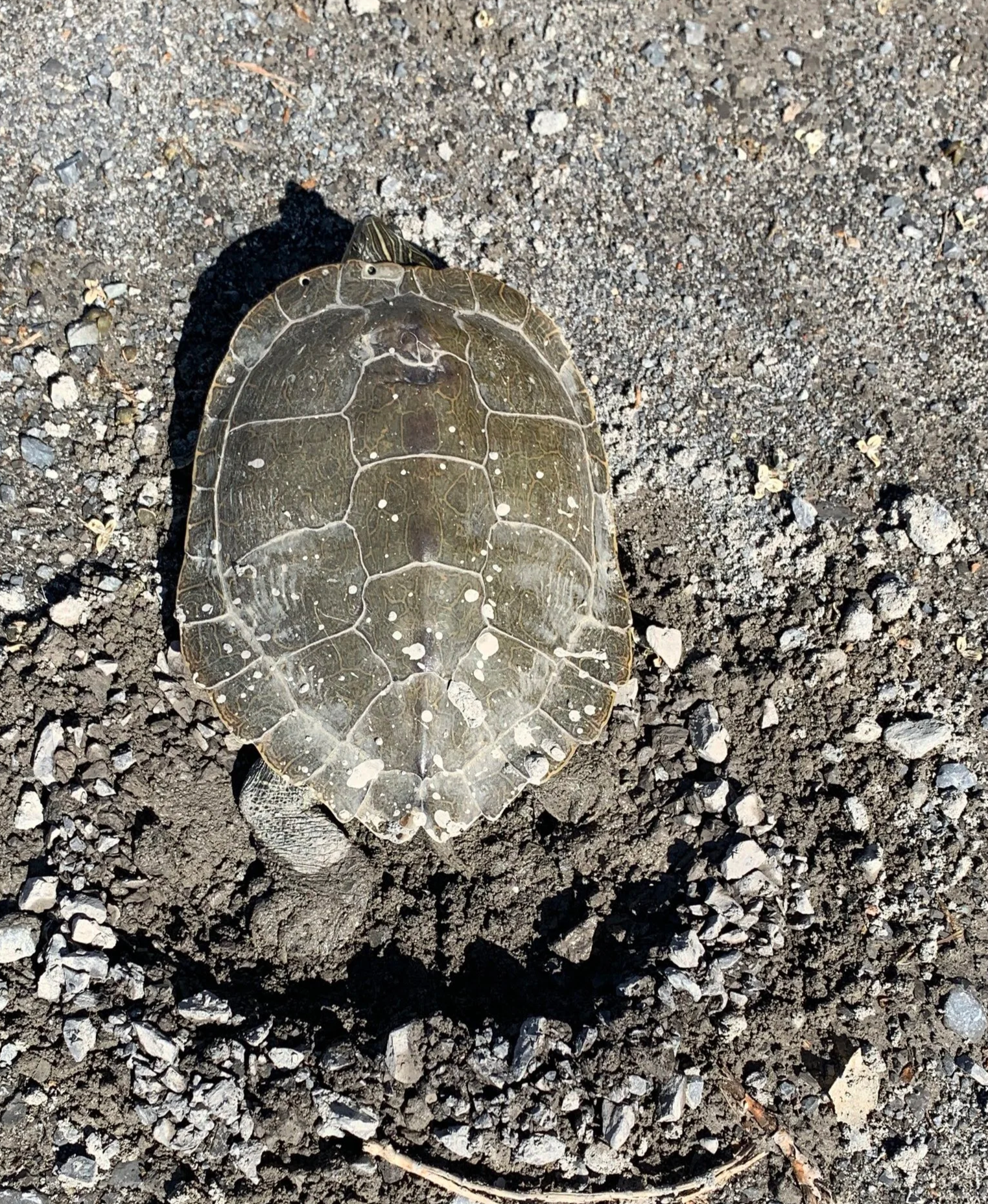
Northern map turtle nesting in the gravel of a parking lot
The Northern Map Turtle is named for the map-like lines on its upper shell, or carapace, which resemble contour lines on a map. These lines are usually yellow, tan, or orange and are outlined by dark borders. The rest of the carapace is typically olive green or greyish brown, while the lower shell, or plastron, is a light yellow to cream color. A distinct yellow spot can be found behind the eyes, and both the head and legs feature a complex pattern of bright yellow lines.
Northern map turtles typically nest from late May to July, preferring unshaded sites with sandy, well-drained soil near water bodies such as rivers and lakes. They dig their nests in sandy areas, usually within a few hundred meters of the water’s edge. Females lay 10 to 22 oval, flexible-shelled eggs in a single clutch, which incubate for 50 to 70 days. Most eggs hatch in late August or September, though if a nest hatches late, the hatchlings may overwinter in the nest.
Eastern Musk Turtle
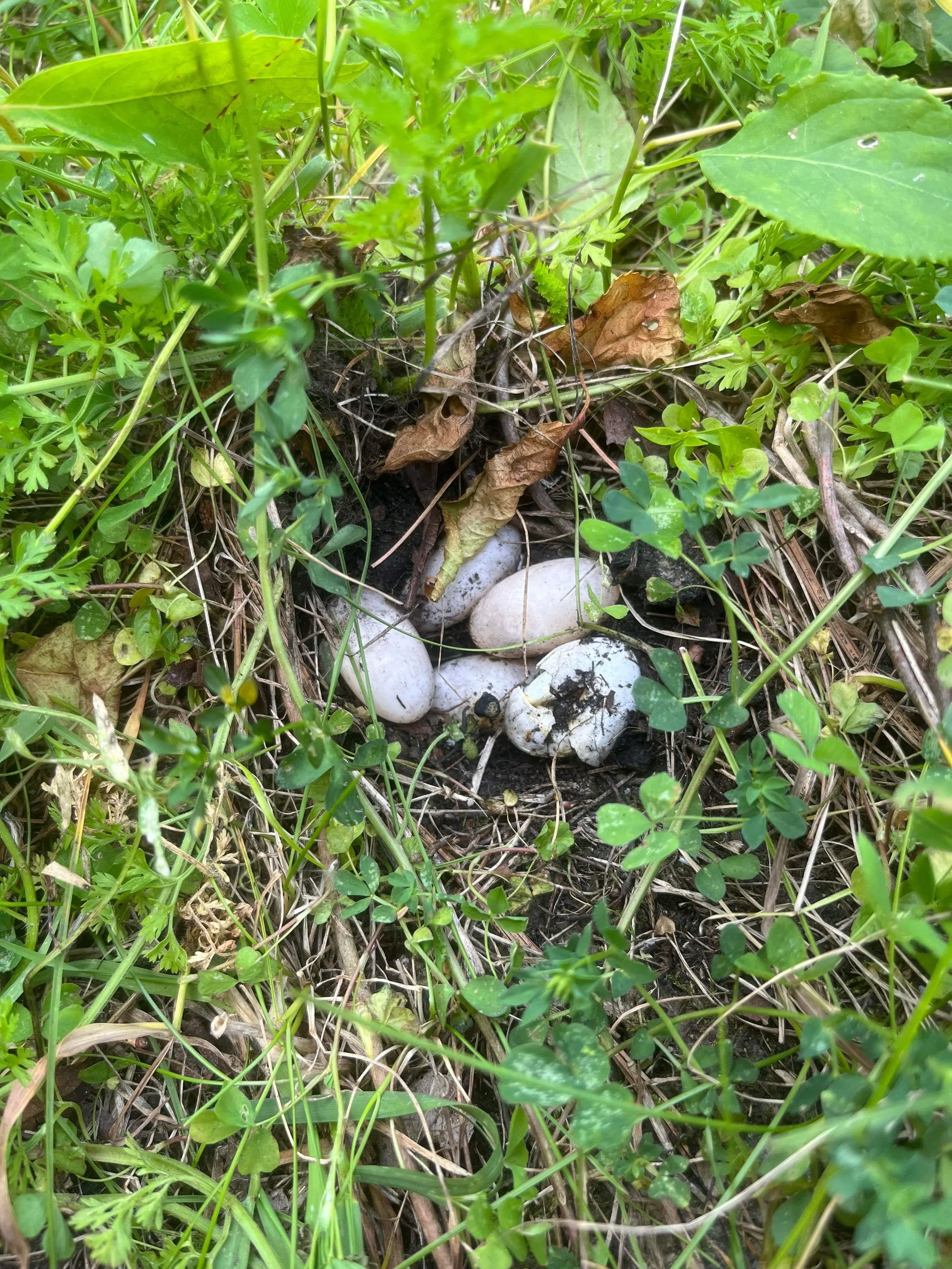
Eastern musk turtle eggs where were lain in the open just slightly under loose grass, not burried.
The Eastern Musk Turtle, also known as the Stinkpot, is a small freshwater turtle recognized for the musky, skunk-like odor it emits when disturbed. With its narrow, highly arched shell, typically less than 13 centimeters in length, it stands out from other Ontario turtles, which generally have wider, flatter shells. The Eastern Musk Turtle has a dull black-brown body, marked by two distinctive yellow stripes on the sides of its head. This species inhabits slow-moving ponds, lakes, marshes, and rivers that feature abundant emergent vegetation and muddy bottoms, where they burrow for winter hibernation.
Eastern musk turtles’ nest from late May to early July, typically choosing locations close to water, often within a few meters of the shoreline. Their nests are usually shallow, reaching a maximum depth of about 10 cm, and can be found in decaying vegetation, rotting wood, sand, sparse shoreline grasses, or even in the walls of muskrat and beaver lodges. In some cases, they may scrape away debris to cover the eggs instead of digging a traditional hole. Females lay 2 to 5 elliptical eggs per clutch, usually at night. The incubation period lasts around 65 to 86 days, with hatchlings emerging in August and September.
Wood Turtle
Historically referred to as the "old red leg" due to the orange or brick-red color of its legs, the Wood Turtle is a medium-sized species that reaches its full size of 20-24 cm by the age of 20. Unlike other turtles in Ontario, Wood Turtles do not shed their scutes (the sections of their shell), which gives them a rugged, gnarled appearance as they grow older.
Wood turtles prefer to nest in sandy or gravelly areas along riverbanks or streams, often on bars or beaches that receive plenty of sunlight. They also utilize anthropogenic open-canopy sites such as gravel pits, road shoulders, and decommissioned railway beds for nesting. The nesting season typically occurs between late May and early July, with each clutch containing 3 to 20 oval eggs. To avoid flooding and predation, females dig their nests in elevated areas and cover them with leaves or dirt after laying their eggs. When selecting a nest site, females choose locations based on soil temperature, favoring warmer conditions, but they are not particular about soil composition.
Spiny Softshell Turtle
The Spiny Softshell is a medium-to-large freshwater turtle that stands out due to its distinctive shell, which is round, flat, and leathery, reaching lengths of up to 54 centimeters. It is also easily identified by its snorkel-like snout. Unlike other turtles in Ontario, the Spiny Softshell has a soft shell, which is typically olive or tan with dark blotches and small spiny projections along the front edge. The body of the turtle is usually olive, brown, or grey in color.
Spiny softshell turtles nest from late May to mid-July, preferring open, sandy or gravelly areas near water, often on sandbars or riverbanks. They dig flask-shaped cavities in the ground, which are bowl-shaped with a narrow opening leading to a larger egg chamber. Females typically lay between 12 and 38 eggs per clutch, with hatching occurring in late summer or fall. To find a suitable spot for nesting, females probe the ground with their snouts. They are capable of nesting multiple times in a single season. Unlike many other turtle species, the sex of spiny softshell hatchlings is determined by genetics, not incubation temperature. However, these turtles face significant threats, including habitat loss, degradation, and fragmentation caused by shoreline development and agricultural activities.
Spotted Turtle
The Spotted Turtle is one of Ontario's smallest turtles, with a shell that typically doesn’t exceed 13 centimeters in length. It is easily identifiable by its smooth black shell adorned with bright yellow-orange spots. The head and limbs are also black, marked with similar yellow-orange patterns. These turtles primarily feed on aquatic insects, crustaceans, and worms.
Nesting for Spotted Turtles typically occurs in mid to late June. Females prefer to dig their nests in sunny areas with well-drained, sandy or loamy soils, often choosing spots with minimal woody vegetation and located close to their aquatic habitats. They create a flask-shaped cavity, usually 2 to 2.5 inches deep, to lay their eggs. Common nest sites include grassy tussocks, sedge or sphagnum moss, marshy pastures, and the edges of roads. Clutch sizes range from 3 to 7 eggs, with an average of around 5 eggs per clutch. The eggs generally hatch in late summer or early fall, typically in August or September. Additionally, Spotted Turtles may enter a state of summer dormancy, or torpor, in terrestrial or aquatic environments from July through August, and sometimes into September or October.
References:
Edge, C. B., Steinberg, B. D., Brooks, R. J., & Litzgus, J. D. (n.d.). Habitat selection by Blanding's turtles (Emydoidea blandingii) in a relatively pristine landscape. Geohub. Retrieved from https://geohub.lio.gov.on.ca/datasets/mnrf::wetland/explore?location=36.097118%2C-37.491030%2C2.21
Edge, C. B., Steinberg, B. D., Brooks, R. J., & Litzgus, J. D. (n.d.). Habitat selection by Blanding's turtles (Emydoidea blandingii) in a relatively pristine landscape. Ontario Turtle Conservation Centre. Retrieved from https://ontarioturtle.ca/
Ontario Nature. (n.d.). FAQ about turtle nests. Retrieved from https://ontarionature.org/faq-about-turtle-nests-blog/#:~:text=In%20Ontario%2C%20turtle%20nesting%20season,and%20exposure%20to%20the%20sun.
Rasmussen, M. L., & Litzgus, J. D. (2010). Habitat selection and movement patterns of spotted turtles (Clemmys guttata): Effects of spatial and temporal scales of analyses. Journal of Herpetology, 44(4), 582-592. https://doi.org/10.1670/09-257
Hughes, G. N., Greaves, W. F., & Litzgus, J. D. (2017). Nest-site selection by wood turtles (Glyptemys insculpta) in a thermally limited environment. Journal of Herpetology, 51(2), 193-202. https://doi.org/10.1670/16-067
Mui, A. B., Edge, C. B., Paterson, J. E., Caverhill, B., Johnson, B., Litzgus, J. D., & He, Y. (2019). Nesting sites in agricultural landscapes may reduce the reproductive success of populations of Blanding’s turtles (Emydoidea blandingii). FACETS, 4(1), 51-64. https://doi.org/10.1139/facets-2019-0046
Ontario Ministry of Natural Resources and Forestry. (n.d.). Wildlife and nature. Retrieved from https://www.ontario.ca/page/wildlife-and-nature
Committee on the Status of Endangered Wildlife in Canada (COSEWIC). (2018). Midland and Eastern painted turtle (Chrysemys picta marginata): COSEWIC assessment and status report 2018. Retrieved from https://www.cosewic.ca