
After learning about why turtle nests must remain undisturbed (check out April’s blog post here: Why turtle nests must remain undisturbed), we now direct our attention to what happened inside the nests. At this time of year, November, the hatching season is over and turtles are preparing for winter. But what happened in the nests between April and November?
From the outside perspective it may seem like not much is happening as once the eggs are laid, they remain in the nest for around 60-90 days. But, inside the nest embryos are developing based on temperatures and nesting conditions.
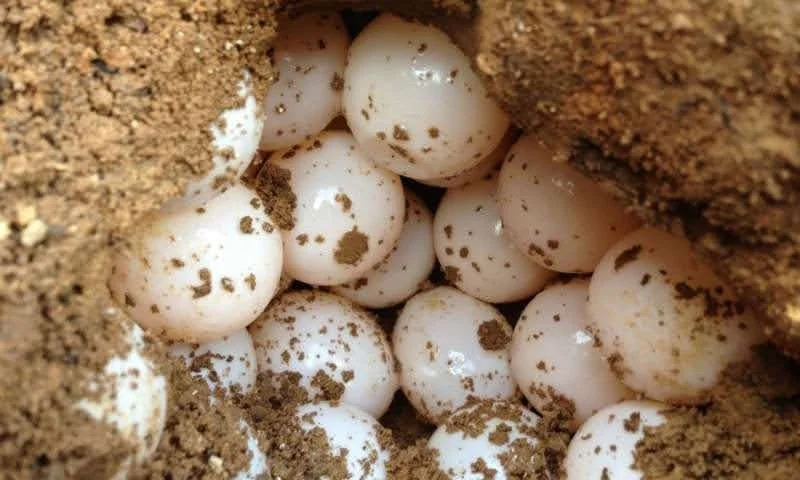
Common snapping turtle eggs inside the nest
Back in June mother turtles took the time to find an appropriate spot (based on substrate and sun exposure) to lay their nests. This location and the care she takes in making the nest is the most important thing the mother turtle will do for her eggs, as once the nest has been adequately covered she does not stick around for the hatching of her offspring.
Similar to a plant, incubation of turtle eggs requires sun and water. The eggs must stay moist (not wet) and they must stay warm. However, the temperature of the eggs is more important than just a heat source, temperature will actually determine the sex of the turtles in those eggs.
In general, a nest below 25-27°C will lead to more (or all) male offspring and a nest warmer than 28-30°C will lead to more (or all) female offspring (Stauffer, 2023). You might be thinking that with such a small nest cavity for the eggs, all turtles in a single clutch will be either male or female. However, there is a temperature gradient within the nest itself particularly between the eggs laid first (on the bottom) and the eggs laid last (on the top). This vertical temperature difference is enough to produce both sexes in the same nest in many cases.
This vertical temperature difference is a result of sun exposure, with top eggs more likely developing into female turtles due to the extra solar heat received from the sun. Alternatively this means the lower layer of this nest will more likely see male offspring development (Salmon, n.d.).

The rate of embryo development is also influenced by the temperature of the nest. Oftentimes, the temperature effects of the sun on the top layer of eggs means that development will be much faster compared to the rate of development of eggs at the bottom of the nest (Matsumoto, Y., & Crews). So not only is the upper layer more likely to produce female turtles, they often develop and are ready for hatching faster.
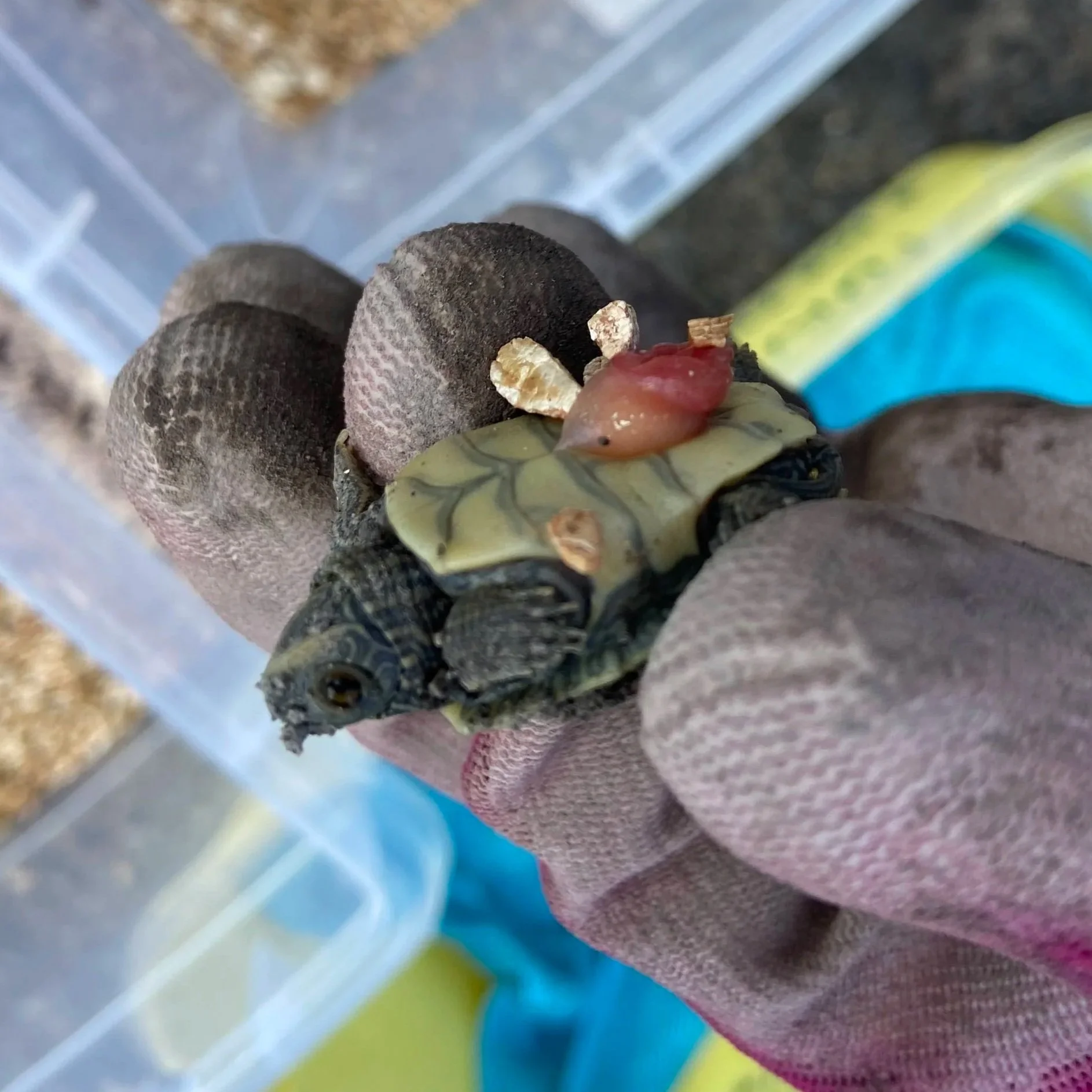
Northern map turtle hatchling with their yolk sac not absorbed yet
Once the eggs have hatched they will rest within the nest while they absorb their yolk sac. Once absorbed, hatchlings will make their way out of the nest, emerging onto the land and finding their way towards water.
This entire time, during incubation and now during emergence, eggs and hatchlings are at risk of being predated. They are the perfect little nutritious snack for many animals including skunks, racoons, foxes, birds, otters, mink, and more. This predation of turtle nests is actually an important part of the ecosystem and helps to cycle nutrients from the nutrient rich water ecosystems to the more nutrient poor land ecosystems. However, near human communities predator populations have exploded and nest predation is near 100%. It is this high predation rate that is a major contributor to the struggling turtle populations in Ontario.
Back to the hatchlings, if you’ve been following Turtles Kingston for any time you will know that hatchlings from several of our turtle species (e.g. Northern Map and Midland Painted) may actually stay in their nests over winter. They have hatched, absorbed their yolk sac and now wait patiently for winter to end, emerging the following spring.
It is not known why some nests of certain species decide to do this, maybe it’s related to air temperatures when they hatching? Regardless of the reason why, some turtle hatchlings are spending the cold winter in their nests, without food and at the mercy of the unpredictable snow cover and temperature changes. Being without food is not really a concern as they wouldn’t be eating during the winter anyways. However, the unpredictable temperatures and temperature changes of the winter season can impact if the nest survives or dies.
Best case scenario for these nest bound hatchling turtles is a large snow pack that provides adequate insulation all winter long. With climate change we know this is not the normal any more. Snow comes and goes and temperatures rise and fall all winter long. If the nest does survive the winter, those hatchlings will finally decide to emerge, making their way to the surface, between March and June, just in time for their mothers to lay the next batch of eggs.
References
Matsumoto, Y., & Crews, D. (2012). Molecular mechanisms of temperature-dependent sex determination in the context of Ecological Developmental Biology. Molecular and Cellular Endocrinology, 354(1–2), 103–110. https://doi.org/10.1016/j.mce.2011.10.012
Salmon, M. (n.d.). Inside a turtle nest: Embryos communicate about when to hatch and when to emerge. National Save The Sea Turtle Foundation. https://www.savetheseaturtle.org/FoundationNews/InsideTurtleNest/
Stauffer, C. (2023). The seasonal quest for a turtle nest!. Biodiversity and Education Awareness Network. https://www.biodiversityeducation.ca/blog/the-seasonal-quest-for-a-turtle-nest